Thursday, 16 September 2010

BLASPHEMY: by Jan Vander Laenen

He's here; in the heathen U.K.! Pope Benedict XVI, is spreading benedictions and holy water all over us, as I write.Here's a little tribute to his Eminence to commemorate his arrival. From the pen of Jan Vander Laenen.

Check out Janine Ashbless' article on the Pope's visit.


As a convinced libertine and fervent adherent of free men’s love, Thomas had every reason to loathe the Catholic church. Hadn’t his entire behaviour been condemned in its ludicrous encyclicals, which were a downright assault on the most fundamental human rights and had an unmistakable Nazi odour; hadn’t he and his brothers been continuously chided from the pulpit by its representatives, a handful of priests who claimed to have a lease on wisdom, but knew nothing about real life, and that his sinful lifestyle could, according to that church, only lead to eternal damnation in the sulphur fires of hell?


No, it was a criminal swindle, the whole Jesus-Mary-Joseph story, and when he turned eighteen, when he was able to shake off the yoke of his traditional upbringing, Thomas had decided not to go into a church ever again.


In the meantime, he reached the age of twenty-six, and it was a sultry summer evening in Brussels, a summer evening when one can literally sniff eroticism and throw all one’s reserves and principles by the wayside.

Such as the principle never to go to church again…


As Thomas was strolling passed a dark, late Romanesque chapel near the Market Square, he came across another lad, a lad who looked at him invitingly and who looked particularly tasty with his sturdy legs and expressive dark head.


Thomas was no greenhorn anymore, he recognised immediately a member of his own, according to the Catholics, damned community, and decided to try to approach this enticing lad at once. He asked him nonchalantly the time. And whether he lived in the neighbourhood.


“I am staying in Antwerp,” answered the lad, with a strange, somewhat funny accent.
“And I do not live nearby,” Thomas had to add.


The lack of an immediately available bed could not however extinguish the urge in either to consume bodies erotically and voluptuously, so they pushed the massive, wooden door that gave access to an nearly empty church, except for an old woman who was praying.


The tiny confessional with purple curtains immediately became their love nest, a love nest where they could paw, and kiss and lick each other to their heart’s content.

And to spit on religion.


Because “repeat after me: Mary was no virgin, Mary was a traitor and had a Roman lover in secret,” Thomas panted while he sucked on his partner’s nipple.


“Mary was no virgin, Mary was a traitor and had a Roman lover in secret,” the young lad repeated in a whisper.

Repeat after me: “Joseph was no saint, Joseph was only a gullible cuckold,” Thomas hissed as he playfully bit his partner on the neck.


“Joseph was no saint, Joseph was only a gullible cuckold,” the young lad repeated.


Repeat after me: “Jesus was not the son of God, Jesus was a mentally deranged compulsive liar and the people were right to nail him on the cross,” Thomas cursed further, while he now kneeled with devotion and left a trace of saliva with his moist mouth on the hairy and curvy buttocks of his partner.


“Jesus was not the son of God, Jesus was a mentally deranged compulsive liar and our people were right to nail him on the cross,” the young lad blasphemed echoing Thomas.


At this point they both climaxed, and sprayed the wood of the confessional with their sinful sperm.


“Did your parents used to force you to attend mass every Sunday too?” asked Thomas by way of after-play when they had had their fill and were on their way out.


“Me?” asked the lad with a mysterious and somewhat indignant smile,” this is the first time that I set foot in a church. I am Jewish.”


“Shalom,” was the only answer that the somewhat surprised Thomas could think of. “If everyone,” the young lad continued, “if everyone had thought like this about Joseph and Mary and Jesus, our people would have been spared a heap of misery.” He gave Thomas a kiss of Judas on the left cheek and left the place of worship.


Thomas stood certainly twenty seconds somewhat surprised against a pillar. Then he took a step to the side, immersed his sperm-covered hands in the holy-water font, and washed them clean.

Thursday, 9 September 2010

LOOK OUT! THE POPE IS COMING!


Yes, Pope Benedict XVI is coming to England. I think he arrives next Thursday. I will not be going to see him -- I expect my Catholic friends will be doing enough genuflecting to compensate for my absence. I’ve wasted enough time, chanting the bloody Rosary, and wishing that something really would happen when I consumed the Body of Christ -- I never did experience Transubstantiation -- I really wanted to. I was constantly disappointed.

So, no, I won’t be going to see this sweet old man. Neither will the writers, Richard Dawkins and Christopher Hitchens. Nor the Human Rights Activist, Peter Tatchell. They might go along to throw eggs, but what they really want is to see him arrested.

What’s he done to inspire such venom? Ignite such a blazing fury? It’s more about what he hasn’t done.

The story goes back to the 1960’s. Top Vatican officials — including the future Pope Benedict XVI — did not defrock a priest who molested as many as 200 deaf boys, even though several American bishops repeatedly warned them that failure to act on the matter could embarrass the church, according to church files newly unearthed as part of a lawsuit.

The internal correspondence from bishops in Wisconsin went directly to the then, Cardinal Joseph Ratzinger, the future pope, shows that while church officials tussled over whether the priest should be dismissed, their highest priority was protecting the church from scandal.

The documents emerge as Pope Benedict is facing other accusations that he and direct subordinates often did not alert civilian authorities or discipline priests involved in sexual abuse when he served as an archbishop in Germany and as the Vatican’s chief doctrinal enforcer.

The Wisconsin case involved an American priest, the Rev. Lawrence C. Murphy, who worked at a renowned school for deaf children from 1950 to 1974. But it is only one of thousands of cases forwarded over decades by bishops to the Vatican office called the Congregation for the Doctrine of the Faith, led from 1981 to 2005 by Cardinal Ratzinger.

It is still the office that decides whether accused priests should be given full canonical trials and defrocked.

Jeffrey Phelps writing in THE NEW YORK TIMES 24th March 2010: tells of Arthur Budzinski, who says he was first molested in 1960 when he went to a Father Murphy for confession.

One case recalls the accusations against Father Lawrence Murphy, who was claimed to have abused up to 200 deaf children, one Italian former pupil claimed that priests had sodomised him so relentlessly that he came to feel "as if I were dead".

And Father Murphy’s point of view?

“I simply want to live out the time that I have left in the dignity of my priesthood,” Father Murphy wrote near the end of his life to Cardinal Ratzinger. “I ask your kind assistance in this matter.” The files contain no response from Cardinal Ratzinger.

In his letter to Cardinal Ratzinger, Father Murphy protested that he should not be put on trial because he had already repented and was in poor health and that the case was beyond the church’s own statute of limitations.

Great! Good for Father Murphy. What about those poor children. They carry the pain and the shame for the rest of their little lives.

The head of the Catholic church is bracing himself for a new round of allegations by victims of paedophile priests — in Italy.

But the Pope won’t be arrested here in the U.K. even though he played a big part in a nasty, sordid cover-up.

What a shame. It was never going to happen; but it was a nice try.

I’m with Richard Dawkins, Christopher Hitchens and Peter Tatchell here.

The Observer's For the record column, Sunday 4 April 2010 states:


Leaders of the Protest the Pope coalition now admit that the Pontiff cannot be arrested as Britain acknowledges him as a head of state, granting him sovereign immunity from criminal prosecution.

“The Pope has sovereign immunity from prosecution under British law; it wouldn't work," said Peter Tatchell, the human rights activist who has previously tried to perform citizen's arrests on the Zimbabwean leader Robert Mugabe and the former US secretary of state, Henry Kissinger. "It's not for want of wishing or trying."

Terry Sanderson, President of the National Secular Society, said; “We have now discovered that there is no real prospect of a prosecution being made against the Pope. Until the status of the Vatican is really sorted out, whether it’s a state or not, the Pope is safe from any kind of legal challenge.”

However the protesters did secure a promise from Archbishop Rev Peter Smith, the Archbishop of Southwark, that he would pass on a request to hand over to police secret files on sex abuse by priests that are held in the Vatican archives, having been investigated under Canon Law.

Peter Tatchell, said: “The Pope's condemnation of sex abuse by clergy will never be taken seriously until he agrees to pass to the police in countries around world the evidence the Vatican has compiled on child molesting priests, bishops and cardinals. Keeping these files secret is wrong and collusion with criminal acts.

"It is no use Benedict meeting victims of sex abuse if he is not willing to hand over his own bulging Vatican files on clerical abusers.”

Wednesday, 1 September 2010

THE BODY OF CHRIST. A short story by Jan Vander Laenen


“Sauveur à l'hostie et au calice (101 x 63 cm, Musée des Beaux-Arts de Budapest” de Juan de Juanes (1523 – 1579).


"Ce qu'il avait fait de mieux
contre l'infâme de M. de Voltaire,
ç'avait e'te' un jour
dame! on fait ce qu'on peut-
de donner un paquet d'hosties a' des cochons!"


(Barbey d'AUREVILLY, A un dîner d'Athe'es)


The number of communion wafers that I have ever partaken of must be roughly the same as the number of men with whom I have hitherto made homosexual love, or so I concluded last summer. It was the eve of World Gay Pride in Rome, and I lay on the bed in my hotel room, somewhere in the district of the Campo dei Fiori, thinking about my own little life in general and the unusual event of the previous day in particular.
My own little life ­ I am now forty ­ can be fairly schematically split into two halves.
The first half was characterised by a very middle-class, Catholic education in a small village in the Kempen region and a boarding school near fascist Antwerp. From age 6 to age 20, about twice a week I attended Mass there and consumed a Body of Christ, which with a little arithmetic adds up to somthing like 1,456 communion wafers.

Add to that a conservative fifty of these sacred items that I, together with other blasphemious pals, went one night and pinched from the pyx in the chapel in order to supplement our poor boarding-school fare, and we reach the round sum of 1,500. During the second half of my life, I have virtually entirely lost my interest in the Body of Christ, although I have nonetheless developed a most overwhelming passion for the bodies of less holy men.

Dwelling on this passion here is of little profit: I have probably experienced a career in love similar to that of a good many of my libertine brothers and it therefore seems to me acceptable to estimate the number of bedmates I have had at something like fifteen hundred.

And whilst in virtually all Catholic regions the Body of Christ has pretty much the same taste and consistency and in principle can only be taken in a church and in the context of the celebration of the Eucharist, the range of tastes of the bodies of other men and the places where one might sample them are naturally much more extensive and varied. The same goes for the emotions that go hand in hand with performance of the two aforementioned activities.

To the best of my recollection, I have always downed by communion wafers somewhat indifferently, or perhaps with a hint of devotion, in short a very nondescript emotion in comparison with the feelings of passion, lust, loving and subservience that my many horseplay partners have been able to wrest from me.

So much for that: these mullings are my foreword to the unusual event that happened to me last summer. I was strolling through the centre of the Eternal City and having walked past twenty-or-so monuments without regard, I was suddenly taken by an unexpected mood of devotion.

Yes, I wanted to confess, I wanted to pray to God and the Holy Virgin and to have myself cleansed by imbibing a Body of Christ. Happily, Rome ­ as everybody knows ­is just riddled with basilicas, churches and chapels, and about a hundred yards up the street I located a small, Baroque house of God in which I could assuage my religious hunger.

And so I set foot into the little church, made the sign of the cross with a few drops of holy water and went and sat on a pew at the back, as the Mass had started. And after first casting my gaze over the interior's sculptures and paintings, my eye suddenly fell on the priest, who was just magicking a chalice of wine into the Blood of Christ. He wore a chasuble. He had a full beard and a serious expression. I reckoned he was about forty. He struck me as familiar, although at that moment I could not remember at all where I might ever have met the man, and I immediately then dismissed this thought as one of those crazy notions that had frequently occurred to me in recent times.

Ten or so minutes later, as I was shuffling up the queue for my portion of Holy Bread, however, I got a clearer look at the man, and as I eventually stood plum in front of him, looked at him and stuck my tongue out, I thought I could read something akin to amazement in his eyes. Indeed, he was staring at me in wonder, wafer in hand, and for a long moment he stood in this position, as though turned to stone.
'Hello, Jan, how's things?' he eventually said to me in Dutch, at which he gathered himself, murmured 'body of Christ' and with trembling hand laid the wafer on my tongue.

I went and drank a Campari after the Mass, and it was at the pavement cafe that, having racked my brains for ten minutes that the priests' name suddenly dawned on me: Paul Van Gelder.

Well I never, Paul Van Gelder, it was a long time ago, in Brussels, both of us twenty and gay and each not daring to admit it to the other. And all the trouble we went to all those evenings in the student bars round Sint-Gorik's Square to avoid the subject, whilst we were both head over heels in love with one another.

And so on until that evening, that dark November night when you stood unexpected before the door of my study. I let you in, you took me in your arms and changed my mind with a French kiss as passionate as it was long. After this, you took your leave of me and with wavering voice told me that you would be going away from Brussels the next day to start training as a priest.

And so, Paul Van Gelder, you really did become a priest and, as fate had it, twenty years later our paths momentarily crossed again, in Rome, and in a church to boot, in the Holy Year and the day before World Gay Pride. Thanks, Paul Van Gelder, you gave me the most cleansing Body of Christ ever in my sinful existence.

Jan Vander Laenen


For non-Catholics, a brief explanation on where the idea for the Eucharist came from. And also, a definition of Transubstiation.

Matthew 26:26-28: Now as they were eating, Jesus took bread, and blessed, and broke it, and gave it to the disciples and said, "Take, eat; this is my body." And he took a cup, and when he had given thanks he gave it to them, saying, "Drink of it, all of you; for this is my blood of the covenant, which is poured out for many for the forgiveness of sins.


"Transubstantiation" is the official Roman Catholic concept referring to the change that takes place during the sacrament of Holy Communion (Eucharist). This change involves the substances of bread and wine being turned miraculously into the substance of Christ himself. The underlying essence of these elements is changed, and they retain only the appearance, taste, and texture of bread and wine. Catholic doctrine holds that the Godhead is indivisible, so every particle or drop thus changed is wholly identical in substance with the divinity, body, and blood of the Saviour.

Saturday, 28 August 2010

LOVE, LUST, PASSION. WHERE DOES IT COME FROM?


Love's Philosophy:

THE fountains mingle with the river
And the rivers with the ocean,
The winds of heaven mix for ever
With a sweet emotion;
Nothing in the world is single,
All things by a law divine
In one another's being mingle—
Why not I with thine?


Sorry, Percy Bysshe Shelley, it ain’t gonna happen.

Forget it. If that special something is missing, she won’t want to kiss you. Your lips will repel her. Your breath will disgust her. She won’t fall into your arms -- no matter how much you weave your magic with those wonderful words -- it’s just not going to work.

Am I talking about love? Lust? Sexual Attraction? Infatuation? Passion? I don’t know. Probably I’m talking about all of them.

Love -- unrequited love. Thousands and thousands of words have been written about it, by pens far more graceful and elegant than mine.

And the songs. We all have our favourites. Beautiful words, melodies, rhythms and harmonies, that remind us of that one time that special something happened. Makes us yearn for it to happen again.

Thousands of Romance writers, re-write the same story, over and over again. He’s a bastard. She falls in love with him, despite herself. The reader is in love with him too. The reader is addicted to the re-telling of the story. The reader believes in that elusive something.

Nobody can bottle it for sure; that thing that makes it happen. Perfume distillers with all their ancient skills have tried to capture it for centuries. It cannot be done.

If that something is missing, then it can’t be found.

A friend of mine, Lucy had a guy doing some building work in her house. They got talking -- she touched his hand…

Within a second they were in each other’s arms. Within another second their tongues were down each others’ throats -- it happened, just like that. No need to analyse it; there’d be no point anyway. That mysterious, elusive thing had happened.

Time stood still. The overworked phrase suddenly made sense.

What was it? Raw lust? I don’t know; neither does Lucy.

Lucy and her builder are still together, two years later.

But it can hit you at anytime. I do believe it. Eyes meet across a crowded room/restaurant/rock festival. And he/she is there. The one. It may only last for an hour, or days. For some it can last a lifetime.

But what is IT? Where is IT? Why does one person make our juices flow, cocks stand to attention? Another person, leaves us, well…flaccid and dry?

So I guess I have ended up talking about lust. Does lust come first? (pun intended).

Sometimes it smoulders, long and low. Think of all those office Christmas parties. Folk who have barely spared a glance for each other, all through the long year, are suddenly together. Alcohol lowers the inhibitions, and it hits you.

That happened to me, long ago. It took twenty years to burn itself out.

Then months ago, I was convinced it was going to happen again. A guy I knew from a long while back. But when we kissed there was nothing. Nada. Rien.

I felt sad, cheated, disappointed.

So did he…

Sunday, 15 August 2010


A lovely review of BEST S/M 3 from Sharazade -- via Oatmeal Girl.

It’s a little strange that I bought myself a copy of Best S & M III: Still More Stories of Still More Extreme Sex (published by Logical Lust, 2010), and that is because of its title. “Best” is fine, and “III” sounds good, but to be honest, S & M (sadism & masochism) really isn’t my thing. I have no objections to it, on either side, it just doesn’t hold any strong personal interest.

Just to be sure, I checked a dictionary. This definition is for the term sadomasochism, but you could divide it easily enough: The combination of sadism and masochism, in particular the deriving of pleasure, especially sexual gratification, from inflicting or submitting to physical or emotional abuse.

Well, there you go. “Abuse” does not sound appealing to me.

So why buy a whole anthology of it? Well… it was a loaf I bought for one slice. For about a year, I’ve been following the blog of a writer called Oatmeal Girl. Her blog is largely personal reflections, with some poetry and a little fiction. And I just love her writing (even though, yes, she does write a lot about sadism, and masochism… but in a way I like, somehow….).

She’d never published offline before, though. So when I saw an announcement on her blog that she had a story coming out in print, I wanted it!

Of course, the book arrived with more than just her story in it. I told myself that I’d review it if I liked 60% or more of the stories in it, and the fact that this post exists answers that question. Indeed, the whole collection was a delightful surprise.

It is of course not the editor’s fault that I hadn’t read books I and II in this series, so I really had no idea what to expect. I don’t need to embarrass myself by saying what I had expected, but what I found was a collection of stories that focus on psychological interactions between lovers, and it is fascinating.

It isn’t “abuse” at all, not as I understand that word, anyway.

And just some damn good writing.

The collection as a whole holds together well. While all of the stories have some aspect of power imbalance and control, it isn’t all “Mistress Ashley whips slave Derek” (in fact, none of it is). There are physical stories, and psychological stories, and realistic stories, and fantasies, and humorous stories, and dark stories, and stories I’d be hard-pressed to really classify. There’s one that’s all hot foreplay, leaving the actual sex to unfold after the story ends; and one barely refers to physical interaction at all.

I can’t review every story in the collection, and I can’t even review 60% of them, because the review would just go on forever. I’ve chosen therefore just a few. These were stories I especially liked, and also ones I felt I could say something about—because sometimes you can read a story and love it, but just have little to say other than “Wow.” Which does not make a fascinating review.

~ ~ ~
You Wake ahead of the Alarm (Oatmeal Girl)

The first line of the first paragraph, as printed, is
You wake ahead the alarm, the sun knocking on your face
The second paragraph begins like this:
You wake ahead of the alarm, the sun knocking on your
Uh-oh! Did the editor or the printer screw up? That’s the same line! (the second paragraph gets one less word because it begins with an indent, which the first one doesn’t). I double-checked. No… it was deliberate, and each sentence finishes differently.

The third paragraph begins the same way, then repeats an element of the second one (but not the first), like the theme & variation of a fugue. Other words and phrases are similarly picked up and carried through for a bit. It’s enchanting, and it’s not something I’m used to seeing in English writing—although it is very much a characteristic of Arabic writing.

The other feature I liked in this piece was the voice—the narrator uses she (for the woman), but writes to you (a man). It’s tricky to use you (although it’s one of my favourite ways to write), because the reader (in all but one case, at most) isn’t the person in the writer’s head; but pitched just right, it can be very sexy. The she instead of I is even more unusual, and I love the effect. It makes the narrator so much more submissive, so objectified, and I think that little quirk in the writing style says as much about their relationship as what actually unfolds in the scene.

I realize I’ve now written 255 words about this story and not said what it’s about. Well, I guess you’ll just have to buy the anthology and read it. ;)

~ ~ ~
Halloween (Cecilia Tan)
Where I live, there’s a place where the goth kids hang out (and I know many are in their 20’s, but they still seem like “kids” to me). They dress outlandishly—huge spiked hair, dyed in lurid colours; black leather with zippers bustin’ out all over; faces that look like they’ve been attacked by a feral Ronco Rhinestone and Stud Setter (she said, revealing her age). They seem to be screaming for attention, yet they’ve always struck me as fundamentally shy, somehow. Certainly if I talk to them, they shrink back; and yes, I do talk to them sometimes. I’ve asked about hair styling (I’m just really interested in hair!), and I once asked one with the really low-slung pants how on earth they stayed up (he showed me—string! he had string suspenders that went under his t-shirt). I don’t find the goth style attractive, but I do admit to a fascination with that in-your-face/shy dichotomy.

The … OK, what do I call her? protagonist? heroine? female lead? none of those seem fitting. The … girl-that-the-story-is-about in Halloween is just like those kids, or at least as I imagine them. Tan captures that mix of bravado and insecurity, and it’s totally convincing. The girl is aggressive, and scared, and a bit of a jerk, and oddly sweet. It might seem strange to call a story that has more pages of graphic sex than anything else (2 pages of build-up, 12 pages of sex, if you’re counting) “sensitive,” but it is. Sensitive, and really hot.

~ ~ ~
Lucky (Xan West)
I enjoyed Halloween for its realism, and this one for just the opposite reason. This story describes the lengths a slave goes to during the course of an evening to feel owned by her mistress. I’m not a slave, or a lesbian, and I don’t enjoy humiliation. And yet… the story works for me. Again, it comes back to strong writing, and also to being able to articulate the feelings behind the actions. I don’t think there’s much in that story I would actually do, and yet the opening lines speak to me of me:
I need to be forced to name my desires. I need to look them in the eye and accept them for mine. I need to travel that long journey through shame into pride.
It takes a skilled writer to convince me of the reality of a life isn’t at all like mine, and she (he? I don’t even know) (or care) did it; and—trickier still—aroused me while doing so.

~ ~ ~
Empty Vessel (Shanna Germain)


I’ve tried three times now to write about this story, and I keep deleting it. When I try to describe it, it doesn’t come out right. Just read it.
~ ~ ~
Down Below (Jean Roberta)

This story came just at the right time for me, because I’d finished writing one of my own that includes a one-line reference to the novel 1984. And I wondered… but what if someone hasn’t read 1984? If I explain the line, I ruin it. I don’t want to take it out, because I like it. But do I risk losing some readers?


Here, for me, was Jean Roberta’s answer. A good part of the plot of Down Below refers to a short story by Edgar Allen Poe. The two main characters in the story work in a university’s English department, and they discuss the story.

Now, I have to say, I’ve read quite a few books set in university English departments (most of them murder mysteries, which must say something about university English departments), and the part where two characters discuss a book is a tricky one. Certainly professors do discuss books with each other, and they discuss plot and character and setting and symbolism and all that in great depth sometimes. But what they don’t do is summarize the book as if someone who hadn’t read it is eavesdropping in the hallway. They don’t say, for example, “Yes, but then in Chapter 2, Anne moves to Green Gables, situated on Prince Edward Island in North-eastern Canada, to live with Matthew and Marilla Cuthbert, the latter a curmudgeonly old lady beneath whose rough exterior beats a heart of gold.”


So Roberta’s characters talk about the story’s plot (which is relevant to the current story unfolding), but they don’t OVER talk about it. And what I particularly liked is that they didn’t name it. Either you’ve read the story, in which case you don’t need to have it named here; or you haven’t, in which case you’re probably not going to throw aside your Best S & M III and rush out to the library to get it. (But if you haven’t read it and feel you simply must know, then you ought to read Poe’s Collected Works. You’ll find it here, and much more besides!).

Now, I did ask myself how the story would work if you had not read the Poe. It would work just fine. The Poe is an added a layer, a treat for someone who knows it, but the plot unfolds perfectly well without it. Very neatly done. (And I’m leaving in my 1984 line.)

~ ~ ~
Six of the eighteen stories in this collection have been published elsewhere; some may, in the future, be published elsewhere too. However, what makes this a book worth buying is not only the individual stories but how they work together. Eighteen variations on a theme, or eighteen interpretations of a dynamic I’d now be curious to read more about.

Best S & M III contains stories by these authors: Billierosie, M. Christian, Mykola Dementiuk, Shanna Germain, Ralph Greco, Jr., Theda Hudson, Kane, Jude Mason, Oatmeal Girl, Jean Roberta, Jerry Rosen, Jason Rubis, Craig J. Sorensen, Cecilia Tan, Jan Vander Laenen, Sharon Wachsler, Xan West, and PM White.

Thursday, 12 August 2010

MEDIEVAL ALIEN ABDUCTION?


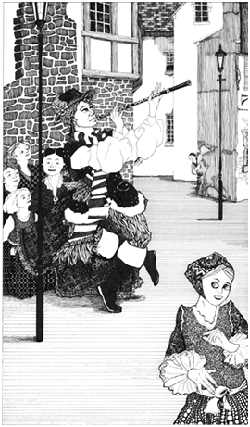
I love Robert Browning’s poem; THE PIED PIPER OF HAMLYN. I love its lulling rhythms, the chanting, lyrical story that it tells.

I went to Hamlyn some years ago; I walked over a bridge, crossing the River Weser, deep and wide…

I came away enchanted; I imagine most tourists do. At the time I never gave much thought to what happened to the children of Hamlyn. If I did, it was of a Disneyfied version.

But it’s a strange story; a whole generation of kids just disappearing. Has anyone ever asked what exactly happened to the children of Hamlyn? Browning’s narrative poem is based on an actual event. Something went very wrong in that quaint German town, so many years ago.

Jack Marx talks about the narrative poem on his blog. The story of what happened to the children of Hamlyn.

Thursday, July 24, 2008.


“Most of the English-speaking world knows of the Pied Piper from the poem by Robert Browning, which itself was adapted from the tale as told by The Brothers Grimm. The story goes that a flamboyantly-attired troubadour promised to rid the town of its rat infestation, which he did by hypnotising the vermin with his flute and leading them to drown in the nearby river. However, when the townsfolk refused to pay him for his services, the piper took revenge by leading the children of the town to an unknown fate, never to return.

As fairytales go, it’s one of the more ghastly, whose moral appears to be little more than a warning about neglecting bills. But the legend seems based upon a true incident whose exact details have vanished into history, to be subsequently coloured in by centuries of folklorists. What is certain is that there is a town in Germany called Hameln and some children did go missing there sometime in June, 1284, the event so significant the early Hameln statutes measured the passing of time in ‘years after our children left.’


But there’s something about the silence in this tale - an event so terrible it remains forbidden to play music and dancing on a certain street in town, that suggests something more dastardly than an organised change of address took place.


Is it just possible that the fate of Hameln’s children was dealt with the townsfolk’s knowledge, if not necessarily their blessing? Perhaps they were sold, ‘donated’, abandoned en masse, or simply neglected, in a moment later regretted. At very least, they were lost, and nobody wants to be responsible for loss, especially a parent.

Enter the Pied Piper, with his seductive ways and other-worldly appearance. It was he who took the children, and then he vanished, an alien abduction for the Middle Ages. He is an invention, a diversion, and an absolution at once. Browning and the Brothers Grimm were probably closer to the truth than the town scribes - the Pied Piper was not so much a tragedy as a dubious transaction, and the less said about it the better.”


The writer, John Boswell, casts children as a kind of burdensome currency in the Middle Ages. All over Europe, they were frequently left to die in the wilderness, sold into the slave trade, used to pay debts, made to ‘disappear’ en masse so that rivals could be blamed and forced to compensate, or, most commonly, “donated” to the church, the return being relief from that mouth to feed and a promise of spiritual dividends.

The Holy Roman Empire turned something of a blind eye to the moral question of child abandonment, (no surprise there then) its various edicts on the matter seemingly more concerned with maintaining a fluid serfdom than protection of the children.

In 13th-century Spain, for example, it was law that “a father who is oppressed with great hunger or such utter poverty that he has no other recourse can sell or pawn his children in order to obtain food.” Furthermore…

“...a father who is besieged in a castle he holds for his lord, may, if so beset with hunger that he has nothing to eat, eat his child with impunity rather than surrender his castle without permission of the lord.”

The Pied Piper story seems to have its root in an event that happened on June 26, 1284. Hamelin historian Martin Humberg states that around 1300 a stained glass window was added to the central market church in Hamelin showing "an old figure of a man in coloured clothes and surrounded by a crowd of children." The inscription around this window has been reconstructed and reads:

“In the year of 1284, on John's and Paul's day
was the 26th of June.
By a piper, dressed in all kind of colours,
130 children born in Hamelin were seduced
and lost at the calvarie near the koppen.”

Scholars disagree on the meaning of "the calvarie near the koppen" but most agree that it refers to a place of execution near an as yet undetermined hill. There are many other references to the story in Hamelin itself, including a street named "Bungelosen Strasse," literally "the street without the sound of drums," allegedly so named because dancing was forbidden in that street in memory of what had happened to the children.”

In A World Lit Only by Fire (1992) by William Manchester, Manchester makes a passing reference to the Pied Piper of Hamelin. According to Manchester the piper was a psychopath and a pederast who was involved in some sort of mass child killing. Many of our children's stories are based on real events, many of them sinister and certainly not the type of thing you would want to lull your child to sleep with, but this seems especially grim. Is this true, and if so what's the whole story?

The quote in question comes from page 66 of Manchester's book and reads;
"The Pied Piper of Hamelin . . . was a real man, but there was nothing enchanting about him. Quite the opposite; he was horrible, a psychopath and pederast who, on June 24, 1484, spirited away 130 children in the Saxon village of Hammel and used them in unspeakable ways. Accounts of the aftermath vary. According to some, the victims were never seen again; others told of disembodied little bodies found scattered in the forest underbrush or festooning the branches of trees."

Manchester doesn't footnote this passage and although he does give a long bibliography at the end of the book, the reader can't readily determine where he got it. The official website of the German town of Hamelin makes no mention of it, which is no surprise, since the romantic version of the legend has monetary value and they have an official town "Pied Piper" to this day. Perhaps Manchester got some of the details wrong -- among other things, he appears to be off about 200 years on the date. But he didn't just make the whole thing up.


The legend of the Pied Piper has probably as many variants as it does tellers. The most popular versions derive from the poem by Robert Browning and the fairy tale by the Brothers Grimm. In pretty much all versions, rats infest Hamelin and the town hires a travelling rat catcher to exterminate them. When he does so, the king, mayor, or whoever decides not to pay him, so he extracts his revenge by spiriting away the town's children.

Taken at face value, the inscription suggests that Manchester was right --130 kids came to a bad end at the hands of a deviant. But there is no corroborating record of any mass execution of children in the vicinity of Hamelin, which would seem to be an important event if it really happened.

The window with the inscription was replaced in 1660 and is now lost, so we're relying strictly on secondary evidence and not much of that. There doesn’t appear to be any factual basis for Manchester's lurid tale of "disembodied little bodies found scattered in the forest underbrush or festooning the branches of trees."

The earliest versions of the tale make no mention of the piper's skill as a rat catcher--that part of the story doesn't show up in literature until about 1550. It appears that the final tale was a mixture of the true story of whatever happened to the children in Hamelin plus various European rat catcher legends. Stories of an itinerant rat catcher similar to the one in Hamelin show up in Austria, France, Poland, Denmark, England, and Ireland. Duke Froben von Zimmern (1556) was the first to put the legends together into the tale we know today. Fifty years later Richard Verstegan was the first to tell the tale in English and introduce the name "The Pied Piper" in his book A Restitution of Decayed Intelligence.

But there is still too much speculation and not enough evidence to say what actually happened to the children of Hamelin in 1284. A typical conjecture might be; the Pied Piper was a charismatic leader who, in the eyes of the ecclesiastical as well as secular authorities, misled a group of young people in a revival of pagan worship. He and his group were therefore captured and killed.

The Black Death has also been mentioned as a possible suspect, although the plague post-dated most of the legends and would have affected adults as well as children. Earthquakes and the Children's Crusade have also been mentioned as possibilities, but are far from convincing.

One currently popular interpretation comes from Jurgen Udolph and focuses on the variant that the children emerged from the cave either in Transylvania or somewhere in eastern Europe. Udolph believes that the phrase "children of Hamelin" should be interpreted figuratively and not literally. He thinks the tale may refer to an eastward migration of people from Hamelin into the area between Berlin and the Baltic. The theory has root in German historian Wolfgang Wann's conjecture that Bruno von Schaumburg, who was then Bishop of Olmutz, recruited some residents of Hamelin to settle in Moravia. This would have happened in 1281, three years before the date in question.

Udolph rejects this particular idea but thinks something along the same lines may have occurred. He uses place names to fortify his speculation, on the theory that people who relocate to a new land tend to name their new homes after the places they came from. Therefore, it should be possible to trace new settlements by establishing the origins of their names. In an article in Time International, Ursula Sautter reports:

"After the defeat of the Danes at the Battle of Bornhoved in 1227, the region south of the Baltic Sea, which was then inhabited by Slavs, became available for colonization by the Germans." The bishops and dukes of Pomerania, Brandenburg, Uckermark and Prignitz sent out glib "locators," medieval recruitment officers, offering rich rewards to those who were willing to move to the new lands. Thousands of young adults from Lower Saxony and Westphalia headed east. And as evidence, about a dozen Westphalian place names show up in this area. Indeed there are five villages called Hindenburg running in a straight line from Westphalia to Pomerania, as well as three eastern Spiegelbergs and a trail of etymology from Beverungen south of Hamelin to Beveringen northwest of Berlin to Beweringen in modern Poland.

Udolph's explanation seems likely. Like most legends, the Pied Piper story probably has its origin in something more prosaic than fantastic.
But the fantastic does make a much better fairy tale.

Thursday, 5 August 2010

HAPPY EVER AFTER?


What is it that we want from an erotic story? What do I want from an erotic story?

I want to be allured, spellbound, challenged. It’s the same that I want from any story. I want to be lulled; drawn into a different, strange new world. Doesn’t matter whether the storyteller sets it in the past, the present or the future; or even if it’s a different world, with strange, unrecognisable characters. I want a story, a yarn, a carefully, well crafted tale.

The strange made normal. The normal made strange.

Vladimir Nabokov’s LOLITA, is one of the best stories I’ve ever read. It’s narrated by the very weird, Humbert Humbert. Is he a liar? Is he just manipulating the story to suit his own sinister purpose? Shifting blame?

It’s left up to the reader to decide. And I like that.

I like being able to choose the ending that I think suit’s the story best in Charles Dickens’ GREAT EXPECTATIONS and in John Fowles’ FRENCH LIEUTENANT’S WOMAN.

Or if the writer gives me an ending, I want to wonder about the characters. Where do they go? What happens to them after I close the book?

That sort of stuff satisfies me, as a reader.

But what I don’t like in any story, is when at the end, the characters have no hope. For that reason I don’t get along with Thomas Hardy. I can’t bear the lack of hope in TESS OF THE D’URBERVILLES. And I just knew that Bathsheba sending that Valentine’s card to Farmer Boldwood, in FAR FROM THE MADDING CROWD, would end in tears. And as for JUDE THE OBSCURE…well! So Thomas Hardy isn’t on my list of favourite writers. Yes, Hardy writes wonderful poetic prose; but I want more.

I don’t believe that in life there is no hope -- or perhaps I’m using the wrong phrase. I believe that there’s always a “what happens next”. And that’s what I want in fiction; what happens next. What happens to Lolita?

Giselle Lorimer is a new writer, who already is getting a cult following. Her first book, sets a standard hard to follow, both in truly erotic content and in the originality and sensitivity of the writing.

She is the author of several BDSM novels published by Silver Moon Books. Her works include ENSLAVING ANNA, BOUND TO PLEASE and OWNING LAURA. Generally they are the story of an inexperienced, virginal woman forced into becoming a sex-slave and subjected to great sexual abuse, pain and humiliation. They are similar to (and probably inspired by) STORY OF O. They are very explicit works and not for the squeamish.

I’ve read all of Giselle Lorimer’s trilogy. Erotic, sexy, pornographic and I enjoyed them.
Yes, I enjoyed the fantasy of total submission, humiliation, degradation. Just as I enjoyed STORY OF O and O’s decline and fall.

There’s no doubt that Lorimer is a sophisticated writer. She knows how to draw the reader in and hold attention. She’s great at atmosphere and at weaving a story.

So while I enjoyed Lorimer’s trilogy, I was left feeling dissatisfied because she leaves her characters without any sort of hope. If the characters “are on a quest for meaningful human contact,” as one reviewer suggests, they, and the reader, are bitterly disappointed. There is no love; not even adoration for their masters. Just control and manipulation. In the end I found the stories bleak; there’s a sadness about these girls. Even within the framework of total submission their only goal is the orgasm. There isn’t “a what happens next.” There is no next; the girls are sex slaves and that’s it.

In ENSLAVING ANNA, Anna is continually plundered by her masters. She is unable to put up any sort of resistance to them, because of the wild intensity of her orgasms. She is a walking, talking blow up doll. Indeed, in the final pages of the book, she is “modified”. Her beautiful, voluptuous breasts are enlarged to the extent that they are “comedy” breasts. She also has an implant so that her masters can force her to orgasm by remote control.

In BOUND TO PLEASE, Charlotte is defiled by her masters. She is used, abused, degraded, forced into their depraved games; yet she is unable to help herself. She loves it, and does not have the will to walk away. In the second half of the novel she is given injections by her master, to induce lactation. She is in the hands of dominant and cruel men, and Charlotte is catapulted into a series of trials and tribulations which have only one thing in common: each one involves more humiliation than the last. And each time she is convinced that she has reached rock bottom, her masters dream up something else, until she at last comes to realise that her destiny really does lie in being Bound to Please

In OWNING LAURA, , Laura lives in a world where women's destinies are rigidly controlled by the state -- they can be either chaste "untouchables" or merely dumb instruments for men's pleasure -- Laura's fantasies are dangerous. Born into a family of wealth and power, she seems condemned to a life as one of the pure untouchables -- married off to any wealthy old man her father chooses for her. But her desires lead her to play perilous games.

This is the only book of Lorimer’s, where I got the idea that Laura was searching for something meaningful. Of course her sexual appetite is as rapacious as that of Lorimer’s other heroines, and that is her downfall, but, still there is a sense that she desires a sort of fulfilment. She briefly finds a sort of happiness. But still, the only “what happens next” is for Laura to live her life as a sex slave.

I try to give a “what happens next” slant to my own erotic fiction. Even men and women who have embraced the life of sexual slavery; they celebrate their orientation. Sometimes through their tears; but they are reconciled within themselves.

I’m romantic enough to believe that a total giving of the self, whatever form it takes, is about loving.

I remember an erotic story I read a while ago by Janine Ashbless. THE FAIREST OF THEM ALL. It’s in her CRUEL ENCHANTMENT collection. I read it again last night. It’s about two women, set in long, long ago. Draughty castles, hard, stone floors covered in rushes. Splendid feasts; much wine, “roast and gilded pigeon” to dine upon.

A stepmother and her stepdaughter. The two embrace their newly discovered roles as Dominant and submissive.

The point I am making is that I left the story with a sense of curiosity. What happens afterwards? I am free to wonder; indeed wander.

The same with Jude Mason’s characters. They have a future that I can think about beyond the ending of the novel. And M.Christian’s novel, RUNNING DRY. What does happen to Shelly after the confrontation in the desert? Where does she go?

Yes “shit happens” in life, and in fiction. Often there seems to be no resolution. I don’t mind the shit happening, but I do want to contemplate what the shit is that’s happening next.